


Quick verdict
Choose the fabric with published results for the risks in your home. A performance label is useful only when the seller names the performance goal, such as resistance to liquid, staining, abrasion, pilling, or fading. A microfiber label tells you that the yarns are very fine, but it does not prove any of those outcomes. If two swatches feel equally good, the better-documented upholstery wins.
Performance fabric and microfiber sit at different levels of a textile specification. Performance refers to what a supplier says the finished upholstery is designed or treated to do. Microfiber refers to the size of the yarn or fiber used to make a fabric.
That means the same cover can be microfiber and performance fabric at once. It can also be microfiber with no published stain or abrasion data. For a pet owner, the strongest choice is the one that turns marketing words into testable details.
Sources checked: AATCC microfiber definition · ACT Contract Textile Glossary · ACT Performance Guidelines · ACT Abrasion Disclaimer · Sol Place FAQs
Key details compared
Performance fabric and microfiber answer different questions, and the table makes that plain. Performance describes what a fabric is meant to do. Microfiber describes how fine its yarns are. Each row, from stain resistance to pet-hair release, shows which label actually tells you something useful about life with a pet.
Look at the abrasion and stain rows. A documented performance fabric can point to test data, while the microfiber label alone supplies none. Claw snagging and hair release come down to construction and a swatch test either way. Use the practical edge column to see which claims still need proof.
Compare the exact configuration, care rules, and open footprint before deciding. Category labels alone do not guarantee comfort or durability.
| Criterion | Performance fabric | Microfiber | Practical edge |
|---|---|---|---|
| Core meaning | A market category tied to one or more intended performance properties. | Very fine synthetic yarns, defined by linear density. | Different questions |
| Stain resistance | May include a stain-resistant finish or fiber-level technology; verify the claim and care limits. | Not guaranteed by yarn fineness. | Documented performance fabric |
| Claw snagging | Depends on whether the surface is flat, looped, knitted, woven, or piled. | Often made into dense, low-profile surfaces, but finished construction still controls snag risk. | Depends on construction |
| Abrasion and pilling | Can be supported by Wyzenbeek or Martindale abrasion data plus pilling results. | The label does not supply a test result. | Documented performance fabric |
| Cleaning | Care method varies by coating, fiber, dye, backing, and cushion construction. | Care method also varies; do not assume every microfiber accepts water-based cleaning. | Tie |
| Pet-hair release | Smooth options can vacuum clean quickly; textured options may hold fur. | Dense faces may release hair well, though static and texture change the result. | Swatch test |
Measure first Confirm delivery access, closed dimensions, open depth, and walking clearance before ordering.
Side by side
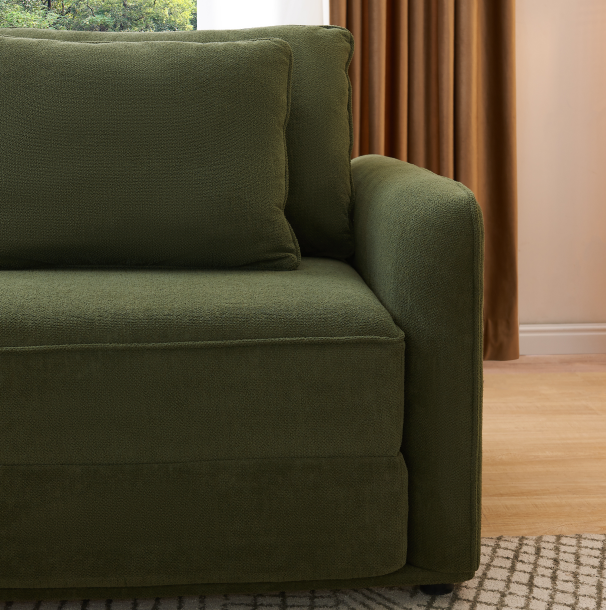
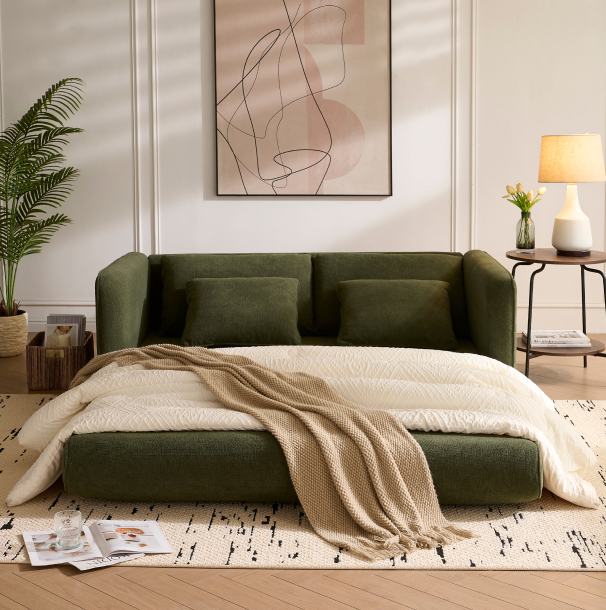
Each card shows a fabric category with its best fit, strengths, and tradeoffs. Performance fabric suits buyers who want a cover matched to named household risks, such as liquid, stains, or abrasion. Microfiber suits buyers drawn to a soft, dense, low-profile surface that is common across many price levels.
The tradeoffs show why evidence matters. Performance has no single universal residential standard, and one property does not prove another. Microfiber does not prove resistance to stains, claws, pilling, or abrasion. In both cases, the better choice is the fabric whose seller tells you exactly what it was tested for.
Option A
Performance fabric
- Core meaning
- A market category tied to one or more intended performance properties.
- Stain resistance
- May include a stain-resistant finish or fiber-level technology; verify the claim and care limits.
- Claw snagging
- Depends on whether the surface is flat, looped, knitted, woven, or piled.
Best for: Buyers who want a cover matched to named household risks
Strengths: Can target liquid, stain, abrasion, pilling, or light exposure; Good suppliers publish test methods and care limits; Available in smooth, textured, woven, knit, and coated constructions.
Tradeoffs: The term has no single universal residential standard; One performance property does not prove another; Treatments and coatings can require specific care.
Option B
Microfiber
- Core meaning
- Very fine synthetic yarns, defined by linear density.
- Stain resistance
- Not guaranteed by yarn fineness.
- Claw snagging
- Often made into dense, low-profile surfaces, but finished construction still controls snag risk.
Best for: Buyers drawn to a soft, dense, low-profile textile surface
Strengths: Very fine yarns can form a compact face; Often soft to the touch; Common across many price levels.
Tradeoffs: Does not prove resistance to stains, claws, pilling, or abrasion; Static and oily residue can affect some products; Cleaning code and backing remain product-specific.
Feature checklist
A good question gets you further than a good label. The checklist gives you the first question to ask, the most revealing document to request, and the mistake to avoid for each fabric. A technical data sheet with abrasion, pilling, colorfastness, and care information is the document worth asking for.
The Sol Place row shows what clear disclosure looks like. The Sunset's smooth performance fabric is 100% polyester with a water-based repellent treatment, and Sol Place does not label it microfiber. It is water-repellent, not waterproof, which is exactly the kind of limit a careful buyer wants stated.
These are the details most likely to change ownership experience. Verify current product specifications and policies before purchase.
| Feature | Performance fabric | Microfiber |
|---|---|---|
| First question to ask | Which performance properties were tested, and by what method? | What is the finished construction, fiber content, and cleaning code? |
| Most revealing document | Technical data sheet with abrasion, pilling, colorfastness, and care information | Full upholstery specification, not a product title alone |
| Mistake to avoid | Assuming water-repellent means waterproof or claw-proof | Assuming fine yarns automatically create a stain-proof couch |
| Sol Place context | Sunset's smooth performance fabric is 100% polyester with a water-based repellent treatment | Sol Place does not identify that upholstery as microfiber |
Which fits your home?
Real households make this choice clearer. Each card names a situation, a pick, and the reason. A dog with wet paws calls for documented performance fabric, because liquid and soil matter more than yarn size. A cat that snags open textures calls for the smoother, tighter swatch after a gentle inspection.
The last card helps if you are comparing sofas online. Give more weight to the seller that publishes fiber content, care rules, dimensions, frame and foam materials, trial terms, and liquid-claim limits. Sol Place states that its upholstery is water-repellent, not waterproof, and that the covers should remain on the cushions.
A dog that comes inside with wet paws
Choose documented performance fabric.
Liquid and soil management matter more than yarn size. Look for a written stain or liquid claim, a care method you will actually follow, and a swatch that returns to its normal appearance after approved cleaning.
A cat that snags open textures
Choose the smoother, tighter swatch after a gentle snag inspection.
Surface geometry matters. Compare a flat, tightly constructed performance fabric with a dense microfiber. Reject obvious loops, loose yarns, and exposed seam details regardless of the marketing name.
A buyer comparing two online sofas
Choose the better-documented sofa, then use the trial to test daily fit.
Give more weight to the seller that publishes fiber content, care instructions, exact dimensions, frame and foam materials, trial terms, and the limits of its liquid claim. Sol Place states that its upholstery is water-repellent rather than waterproof and says the covers should remain on the cushions.
FAQ
Performance fabric vs microfiber: FAQ
Quick answers to the questions pet owners raise most. They cover whether microfiber can be performance fabric, whether all performance fabric is polyester, cat claws, double-rub numbers, and what Sol Place publishes about its own fabric.
Can microfiber also be performance fabric?
Yes. Microfiber describes very fine synthetic yarns. A finished microfiber upholstery can also be tested or treated for stain, abrasion, pilling, or light performance. The product needs documentation for those separate claims.
Is all performance fabric polyester?
No. Performance is not a fiber name. Suppliers can build performance upholstery from different fibers, blends, constructions, or coatings. Read the fiber content and technical sheet for the exact fabric.
Which one is better for cat claws?
The tighter, lower-profile finished surface is usually the more sensible candidate, whether it is sold as microfiber or performance fabric. No label proves claw resistance, so inspect a swatch and ask for snag or physical-property data.
Do high double-rub numbers guarantee a longer-lasting sofa?
No. ACT says abrasion results above its guideline do not predict proportional service life. Cleaning, maintenance, physical abuse, application, seams, pilling, and the rest of the sofa construction still matter.
What does Sol Place publish about its performance fabric?
Sol Place lists the smooth upholstery as 100% polyester and describes it as scratch-resistant and water-repellent. Its FAQ says a water-based coating helps repel oil, stains, and liquids, while clarifying that the fabric is not waterproof.
Keep reading
More sofa guides from Sol Place
Scratch-Resistant Sleeper Sofa
Memory Foam vs Innerspring Sofa Bed Mattress: Which Is More Comfortable?
Read more
Scratch-Resistant Sleeper Sofa
Sectional vs Sofa: Which Works Better in a Pet-Friendly Living Room?
Read more
Scratch-Resistant Sleeper Sofa